

A grading crew completes a multi-acre commercial pad, only to discover the entire surface is 3 inches off grade. The design was correct, and the equipment ran consistently. But now you’re looking at full-site regrading, interrupted schedules and lower profit margins.
The problem isn’t always what you think. While accuracy and precision are used interchangeably as if they mean the same thing, they don’t. When your machine control model comes up short in both areas, it becomes an expensive rework. Knowing the difference between accuracy and precision is what separates a profitable job from a loss.
JUMP TO SECTION
Defining Accuracy and Precision on the Jobsite
These terms measure two fundamentally different qualities in your site data and machine control systems. Confusing them costs you more than confusion — you’re looking at expensive errors you won’t catch until your equipment is already working in the field.
What Is Accuracy?
Accuracy measures how close your data comes to the true value. In earthwork terms, it’s about correctness. When your machine control model is accurate, the elevations and design surfaces in that model match the engineer’s specifications exactly. An accurate dozer grades to the true design elevation, not 2 inches high or 3 inches low.
What Is Precision?
Precision is all about repeatability. It’s the degree to which your system produces the same result under unchanged conditions. A precise machine control system delivers consistent measurements and equipment performance, pass after pass. Precision doesn’t guarantee correctness, only consistency.
The Target Practice Analogy
Picture accuracy and precision as arrows hitting a target. There are four scenarios that illustrate how these concepts work:
- Low accuracy, low precision: Arrows scatter randomly across the target, missing the bullseye with no consistent pattern.
- High accuracy, low precision: Arrows cluster loosely around the bullseye but spread out across the center zone.
- Low accuracy, high precision: Arrows group tightly together but land far from the bullseye, consistently wrong.
- High accuracy, high precision: Every arrow lands in a tight cluster at the bullseye center.
That fourth scenario is your goal. You need your data to hit the right target and hit it the same way every time.
Analyzing the Impact on Your Profitability
Getting these definitions right matters because each inaccuracy can affect your budget differently. When your model lacks accuracy, precision or both, the consequences show up as line items on your project financials.
The Financial Impact of Rework
Construction rework costs come from work that didn’t meet specifications the first time due to poor data accuracy or precision. You’re paying crews and equipment twice to complete work you already billed once. For example, on a $5 million project, even a 0.75% rework rate adds up to $37,500 in unplanned costs — money that comes straight out of your margin.
The Outcome of an Inaccurate but Precise Model
This is the “tight cluster, wrong location” scenario from the target practice analogy. Your machine control model is precise, guiding your dozer to perform the same action consistently across the entire site, but that consistent action is wrong.
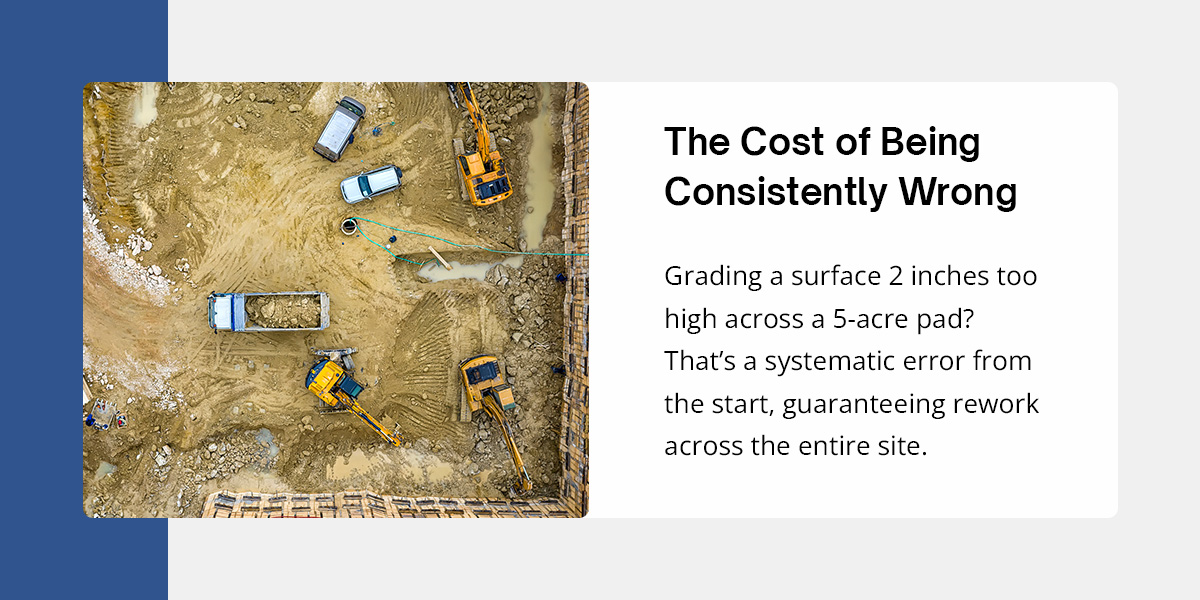
Imagine grading a surface 2 inches too high across a 5-acre pad. The dozer delivers a level surface with minimal variation, but the elevation is off target, revealing an inaccuracy. This mistake has guaranteed rework across the entire site because the model had a systematic error baked in from the start.
Every pass your operator made was inaccurate. And often, you won’t catch the error until survey crews check grades, or you start the next phase, and nothing fits. By then, you’ve spent days of productivity on work that must be redone.
The Impact of an Accurate but Imprecise Model
Now, switch the scenario. Your model’s target elevations are correct, but the data itself is inconsistent. This situation happens when file conversions introduce errors, modeling workflows, cut corners, or quality control gets skipped. Your operator sees guidance that jumps around unpredictably from one blade position to another.
As a result, your crew might lose confidence in the system. Operators slow down, double-check everything manually, and essentially revert to traditional grade-checking methods. You’ve invested in machine control technology but haven’t seen the efficiency gains you expected. Projects take longer, and you’re paying for GPS accuracy you’re not actually using.
Achieve Precision to Build a Reliable 3D Model
Precision in your 3D model creates operational reliability that makes machine control versus traditional earthwork a legitimate productivity advantage instead of an expensive distraction. When your model contains inconsistent or noisy data, often the result of file conversion errors or flawed modeling processes,; operators can’t trust what they’re seeing on their screens.
A precise 3D machine control model provides consistent, trustworthy guidance that lets your equipment operator work at full speed. The blade or bucket moves smoothly from one elevation to the next without erratic jumps or conflicting data points. That consistency is what transforms digital models from design documents into field-ready construction tools that eliminate rework and keep projects on schedule.
Building on a Foundation of Confidence with Take-off Professionals
Accuracy gets your model to the right elevations. Precision keeps your equipment there, pass after pass. You need both, and there’s no room for compromise. Understanding the difference is important. Actually executing it requires specialized expertise, which most contractors handle through outside partners.
Take-off Professionals eliminates that gap. Our team of licensed, knowledgeable and experienced engineers and surveyors has spent over 20 years building verified machine control models. We deliver data that’s both accurate and precise, so your equipment does what it’s supposed to do the first time.
Eliminate bad data risk on your next project. Get a quote and see how professional data preparation protects your bottom line.
